

The Financial Process Maturity Model
A Practical Framework for Assessing and Improving Finance Operations
Before choosing technology, assess the maturity of the financial process you want to improve.
Should we automate reconciliations? Should we modernize reporting? Should we implement workflow? Should we replace spreadsheets?
These questions are understandable. They are also often premature.
Before deciding how to improve a process, organizations should first understand the maturity of the process they already have.
Assessing process maturity helps organizations identify what needs to change first—and direct improvement efforts most effectively:
- automating before defining the work can leave required steps out of the workflow,
- extensively documenting and cross-training a manual process just before redesigning it can mean doing that work twice
Assessment helps avoid omissions and rework—not simply choose software.
Importantly, this model is not intended to measure technology maturity. It measures process maturity.
A process can have modern software and still be immature. Likewise, a process may rely on legacy systems and still operate at a relatively mature level.
The ultimate question is not what tools are being used. The question is whether the process is predictable, efficient, visible, resilient, and sustainable.
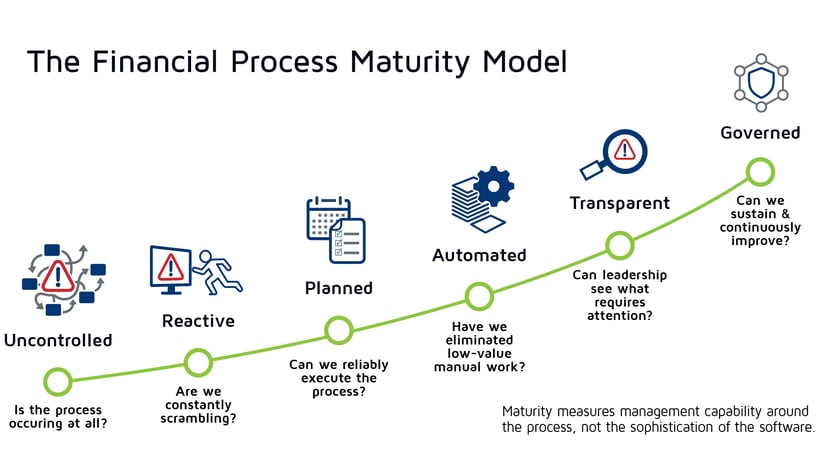 Figure 1. A common six-stage model for assessing the management capability surrounding a financial process.
Stage 1: UncontrolledObjective: ExistenceIs the process occurring at all? Typical symptoms
Common statement: “I think somebody takes care of that.” Next objective: Establish ownership and ensure the process consistently occurs. |
Stage 2: ReactiveObjective: SurvivalAre we constantly scrambling? Typical symptoms
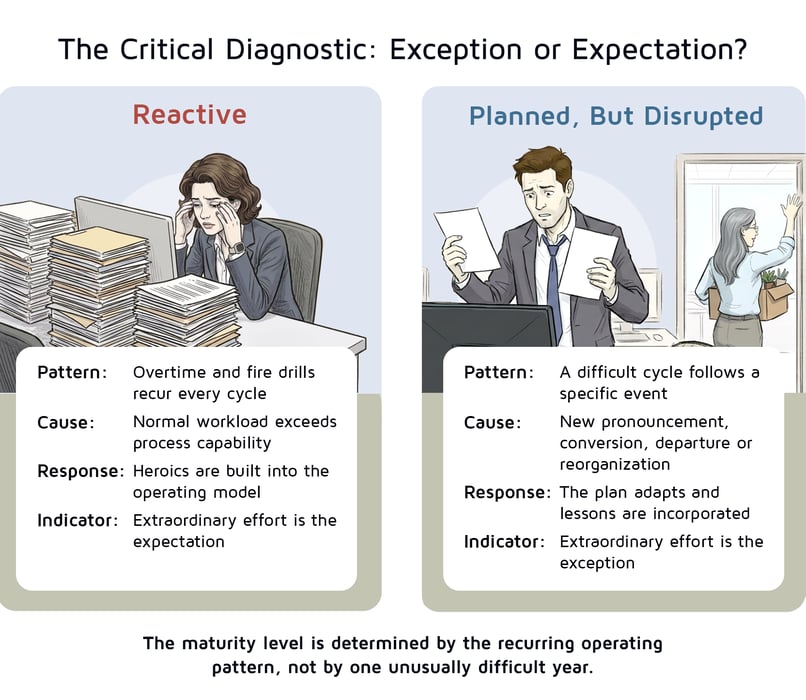
The critical distinctionA single difficult year does not necessarily indicate a Reactive process. A new accounting pronouncement, ERP conversion, major reorganization, or unexpected vacancy may temporarily increase workload.
Figure 2. Recurring operating patterns are more diagnostic than one unusually difficult cycle. Common statement: “We always get it done somehow.” Next objective: Move from recurring fire-fighting to predictable execution. |
Stage 3: PlannedObjective: PredictabilityCan we reliably execute the process? Typical symptoms
Warning signsEven Planned organizations experience new regulations, major technology changes, unplanned staff departures, and significant organizational change. The difference is that these issues are disruptions, not normal operating conditions. Common statement: “We know what needs to happen and when.” Next objective: Reduce effort while maintaining consistency. |
Stage 4: AutomatedObjective: EfficiencyHave we eliminated low-value manual work? Automation is not the objective. Efficiency is. Organizations at this stage deliberately reduce repetitive activities so staff can focus on analysis, review, decision-making, and risk management. Typical symptoms
Warning signReplacing ten spreadsheets with one enormous spreadsheet is not automation. If effort has not materially decreased, the process is probably not Automated. Common statement: “The team spends more time reviewing than preparing.” Next objective: Create operational visibility. |
Stage 5: TransparentObjective: VisibilityCan leadership see what requires attention? The defining characteristic of this stage is visibility. Management can identify risks before they become problems and intervene before they become crises. That visibility also supports productivity: less effort is required to establish status, locate bottlenecks, and determine where to intervene. Typical symptoms
Practical testCan leadership quickly answer the following questions?
If answering these questions requires several emails, meetings, or phone calls, the process is probably not yet Transparent. Common statement: “We know where the issues are before deadlines are affected.” Next objective: Create long-term organizational sustainability. |
Stage 6: GovernedObjective: SustainabilityCan the organization sustain and continuously improve the process? At the Governed stage, the focus expands from executing the process to sustaining and continuously improving it through personnel changes, technology changes, organizational restructuring, and future growth. Process governance
Organizational resilience
Technology governance
Continuous improvement
Practical testA Governed organization can answer “yes” to two questions: If our most experienced employee left tomorrow, would this process still operate effectively next year? Common statement: “The process is bigger than any individual employee.” Next objective: Sustain the process while learning, adapting, and improving. |
How To Use The Model
The goal of this model is to identify the next practical step forward.
Very few organizations operate entirely at one maturity level:
- Financial reporting may be Planned.
- Reconciliations may be Reactive.
- Cash flow forecasting may be Automated.
- Grants management may be Transparent.
The model creates a common language for discussing operational maturity across finance functions. It also helps organizations avoid a common mistake: trying to automate a process that first needs to be planned.
Automation rarely fixes an immature process. More often, it makes an immature process operate faster.
Final Thought
Technology projects often begin with discussions about software. Successful transformations usually begin with discussions about process maturity.
Organizations improve by building capabilities that reinforce one another:
- planning makes execution predictable;
- automation reduces repetitive effort;
- transparency makes status and bottlenecks visible; and
- governance helps sustain and improve performance over time.
Ultimately, maturity is not about technology. It is about creating financial operations that are predictable, efficient, visible, resilient, and continuously improving.
That is the foundation upon which lasting transformation is built.


