

Reconciliation Delayed Is Risk Multiplied
A control-risk perspective for finance leaders, treasurers, controllers, and audit committees.
Most organizations know they should reconcile their bank accounts. The more important question is whether they are doing it often enough, completely enough, and with enough visibility.
For many finance departments, reconciliations remain a manual process performed by a small number of experienced employees on a periodic basis. When workloads increase, vacancies occur, or key staff retire, reconciliations can quickly fall behind.
That situation is more than an operational inconvenience. It is a control risk.
Why Timing Matters
Reconciliations are far more than merely an essential first step in financial reporting. They help identify fraud, bank errors, internal mistakes, and unexpected activity while giving management an accurate view of cash which is critical for accurate cash flow forecasting & investing.
The longer the delay in reconciling, the greater the risk to the organization:
- Errors accumulate,
- Recovery opportunities diminish,
- Institutional knowledge fades, and
- Fraud related losses accumulate (Figure 1)
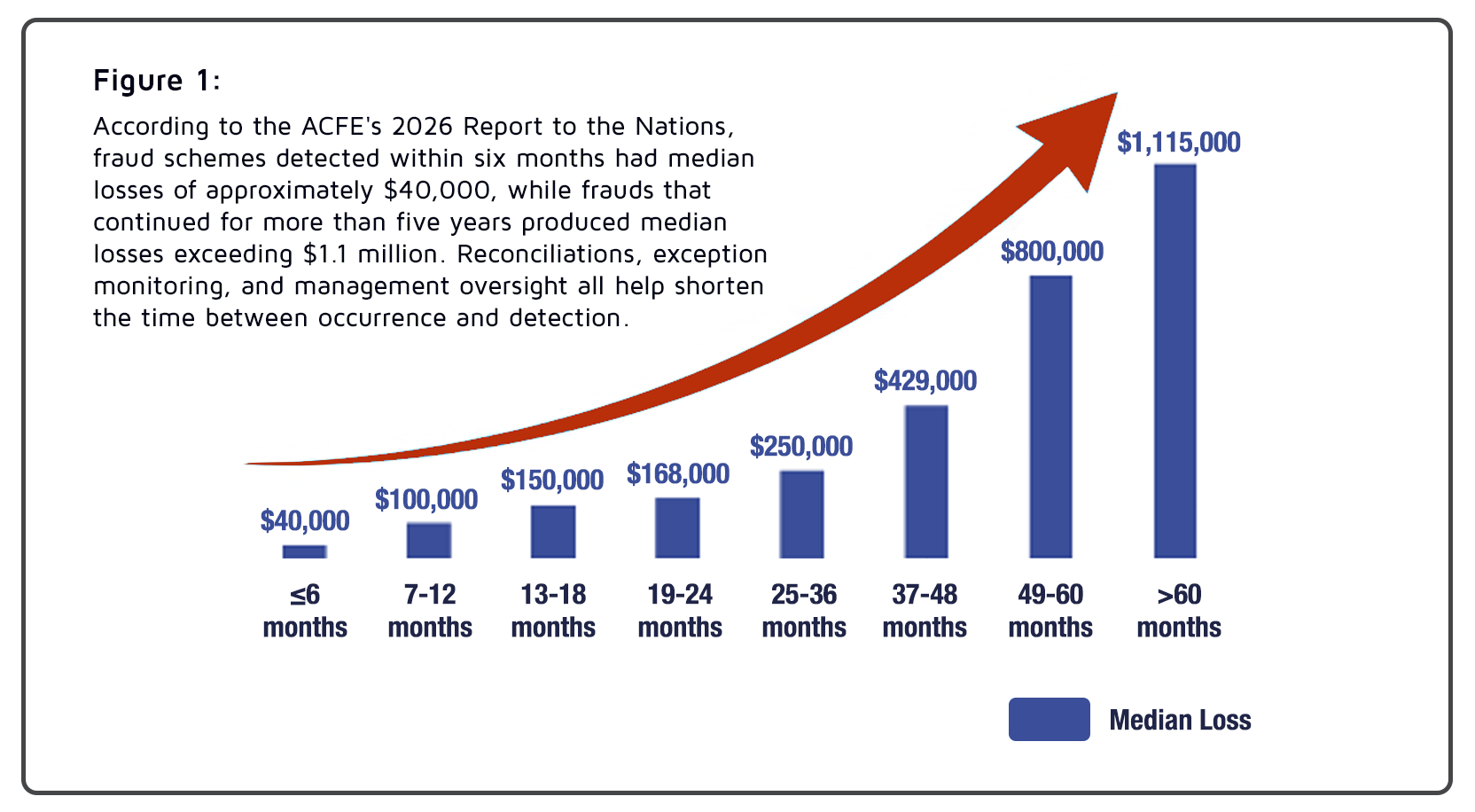
Thus, the value of reconciliation is not simply confirming that most transactions are correct. It is finding the transaction that is not.
That is why timing matters. A reconciliation performed weeks or months after the activity occurred may still identify a problem, but the organization may have already lost its best opportunity to correct, recover, or contain the issue.
Turnover Is the Risk Nobody Plans For
When finance leaders think about risk, they often focus on cyber threats, fraud schemes, or regulatory compliance. Less attention is paid to risk to operational continuity.
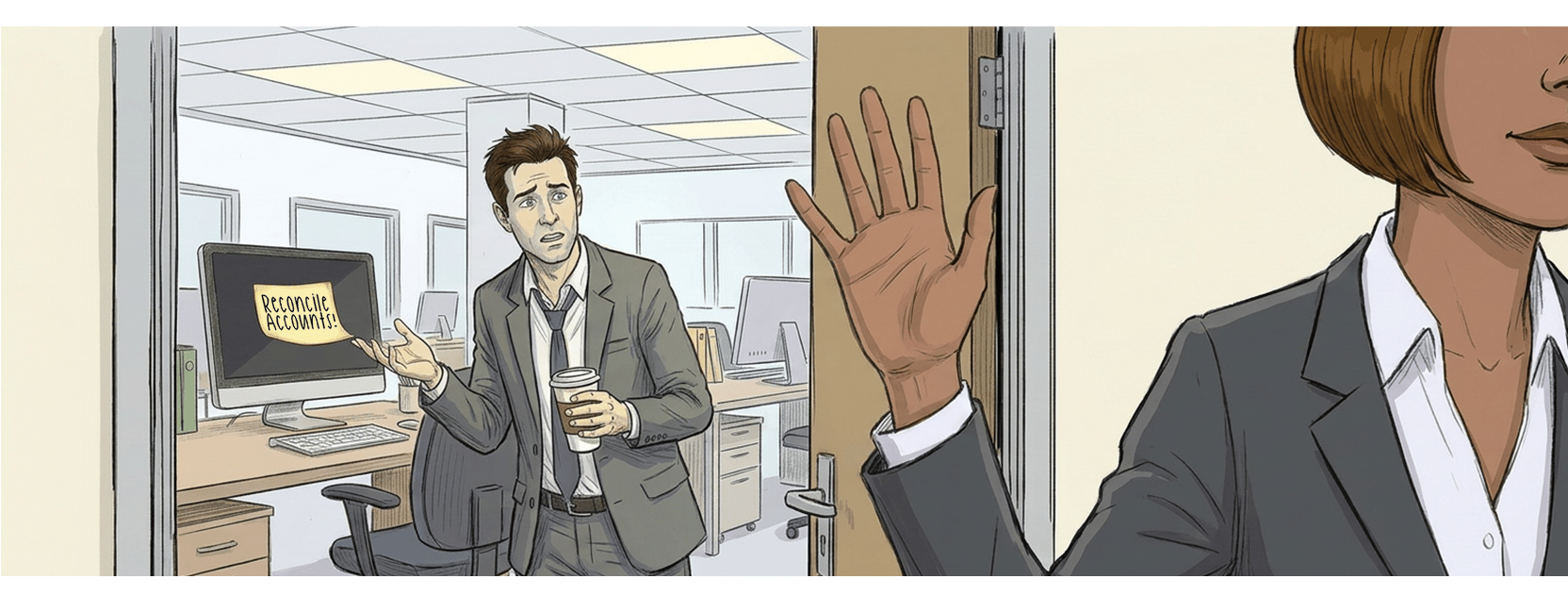
In many organizations, only one or two employees truly understand the reconciliation process. If one of those individuals leaves, critical controls can stop almost immediately.
Reconciliation is too important to reside in the knowledge of a single employee. If a critical control cannot survive the departure or absence of one person, it is not a resilient control.
Reconciliation Modernization Solves an Oversight Problem
The most overlooked risk may be management visibility.
In an environment of manual, decentralized reconciliations most organizations cannot reliably answer basic governance questions:
- Which account reconciliations are overdue?
- How old are the exceptions?
- Are unresolved items increasing or decreasing?
- Would management know if a reconciliation stopped happening altogether?
In that sense, reconciliation modernization is not only about matching transactions faster. It is about giving management timely evidence that a critical control is operating as intended.
That ability creates what every CFO, Treasurer, Controller, and Audit Committee needs: confidence that controls are operating, not simply confidence that controls exist.
A Practical Path Forward
Organizations do not need to transform every reconciliation process at once. A practical starting point is to:
- Identify high-risk accounts,
- Increase reconciliation frequency where the risk warrants it,
- Standardize documentation and review, and
- Give management visibility into completion status and unresolved exceptions.
For organizations already considering account reconciliation modernization, FHB’s broader resources on balance sheet account reconciliations, continuous controls monitoring, Workiva and Adra integration, and public-sector success stories provide useful companion perspectives.
The conclusion is straightforward: reconciliation delayed is not risk postponed. It is risk multiplied.


